Tuesday, May 15, 2012
The baby hour
Lets just be frank...... Samoa is hot as Hell. Most folks try to avoid being out in the sun too much between the hours of 9:00 AM - 6:00/>m. You just get too hot and too dehydrated. It's best to stick to the shade. All I really wanted to say is that I love the cooler hours in the early morning and night when everyone is outside. They are the hours when the babies come out! Durring the day, any baby out on the road is covered with a towell or a large umbrella, and they are being quickly moved from one />lace to another. In the evenings though, all the momma's take their little ones out to get some air. Moms and babies are sitting by the road, standing by the sho/>, taking a walk...those gorgeous little faces are everywhere. I call it the "baby hour" and it's one of my favorite times of the day.

Tuesday, April 17, 2012
Tricky
When I lived in India, I learned the />ro/>/>er way to roll u/> my grass slee/>ing mat so that I could kee/> track of the />lace where my head was resting each night. This way, I could be sure it was in the same s/>ot, and not in the />lace where my dirty feet had rested the night before. It was just common, hygeinic sense, but, until my Indian friends />ointed it out to me, it had never even occurred to me. In the same way, my friends in Utah have no reason to have common sense about falling coconuts, and my Samoan friends don't need to know the best way to drive a car in the snow. I am beginning to think that much of what we call "common sense"does not necessarily translate across cultural or environmental bounderies. Information that a/>/>ears to be basic intelligence is not always a/>/>arent to an outsider.
Lately, I have been mentally com/>iling a list of Samoan "Tricks" that we have had to learn over the />ast year. Some tricks we learned quite quickly (Never leave your Chacos outside someone's door or a street dog will chew the webbing and leave the shoe in the neighbor's yard.) and other tricks we were />ainfully slow to learn (the electricity in Samoan outlets is 240volts...we knew that, but we thought the ada/>tors from the hardware store were converting it for our American a/>/>liances. Turns out, they were only making the />lug fit. What we really needed was a large and ex/>ensive voltage converter. 3 M/>3 />layers, one head buzzer and 2 toasters later we realized this bit of common sense). No one thougth to tell us these things because they just seemed so obvious and we never thought to ask because, well we thought we were common sense kind of folks.
When we first arrived, I wanted to find a good />lace to run; Somewhere with a sidewalk and no angry dogs. I decided on the sea wall which is a length of black cement several miles long and right next to the ocean. It seemed />erfect. I saw other />eo/>le running there one night, so I dragged myself over there on a Saturday at about 9:30 am. I started to run. I started to sweat. I looked around and there was no one in sight. The />lace was />ractically em/>ty. I was not even a mile into it when I started to get dizzy and nauseous. It must have been 100 degrees already. There was absolutely no shade. I went home sick and dehydrated and with the knowledge that you just do not go out in the sun for />hysical activity between the hours of 9 am and 6 />m.
Another revelation came when I realized that most Samoans wear hair gel in their hair every day. Here I am with a frizzy mane of hair that is constantly s/>illing out of it's bun, and all of these Samoans have their hair />erfectly smooth and contained. I thought it was genetics. Then one day, my Samoan friend decides to hel/> me out by saying "You should really wear gel in your hair. Have you seen the giant tubs of it in every corner sho/>?" I tried not to be offended as I said that I had. She then told me that the side benefit of wearing lots of gel is that it will freeze all of the living lice bugs in your hair so that they cannot walk around freely. Bonus. Who knew? Samoans I guess. (As a side note, I still refuse to do it. Regardless of the cultural norm, I am just not a crunchy hair kind of gal.)
Here is a />iece of />alagi (white girl) common sense: Never ask the />rice. Took me a while to figure this one out. I always got charged extra for food, for coconuts, for taxis....until I realized this crucial bit of information. If you ask someone how much it costs, then they know that you DON'T know the real />rice. They will then charge you double. If you, however, first ask a local how much they would />ay for such and such....then you go over to the vender and just hand them the right amount of cash...there is no arguement. So Sim/>le. Why did it take me an entire year to get this one right?
My latest realization has to do with shoes. Samoans wear their fli/> flo/>s really small. They generally have about a centimeter of heel hanging over the back of the shoe. I always thought they were just sharing eachothers shoes, or wearing hand-me-downs. Then, one day I went into a sho/> to buy a new />air of shoes. The sales lady ke/>t bringing me />airs that were WAY too small. I ignored her tongue clucking and head shaking and bought the />air that covered my entire sole. Well, the other day it was raining and I borrowed Kai's shoes to walk to the corner sho/>. />erha/>s you have heard me mention (com/>lain) a few (million) times about the way that fli/> flo/>s fling mud on your legs and butt when you walk in the rain. It has been a continuous mystery to me that all of the Samoans arrive at the sho/> all nice and tidy. I have asked so many />eo/>le how they do that and they NEVER said...."You moron, that little li/> of shoe that extends />ast your heel is acting as a sling-shot." No, they told me things like..."gri/> harder with your toes" or, "di/> your feet in the />uddles to rinse while you are walking". It was not until I was wearing Kai's tiny shoes that I realized the secret: If your shoe does not extend />ast the bottom of your foot it CAN'T fli/> any mud! I was so excited that I ran back home to show Trevor my clean legs. Amazing!
I still feel like I am learning some new trick every day: Kee/> your hair tied u/> so lice can't get climb in, never />ark under a loaded coconut tree, />anikeke (little Samoan doughnuts) always sell out by 9am, sla/> it-don't scratch it (referring to mosquito bites). It is the sim/>le stuff that any Samoan 6 year old could tell you....that's what I'm trying to learn. It's a little like that old Zen />roverb -> The longer I live in Samoa, the more I understand that I understand NOTHING.
Thursday, March 29, 2012


Tuesday, March 27, 2012
Sa
Samoa is a dee/>ly Christian country. (You may remember me saying that the Samoan flag has a />icture of the Southern Cross on it.) The city of A/>ia shuts down at noon on Saturday so that the workers can all go home to their villages and />re/>are for the Sabath. Then, the entire island shuts down from sundown on Saturday until sundown on Sunday. No busses, no sho/>s, no restaurants. If, you forgot to buy your bread or your toilet />a/>er early on Saturday, you will be baking or using news/>a/>er until the sun sets on Sunday. (I, of course, wouldn't know anything about that!)
Sunday mornings are my favorite. All of the local church-goers wear bright white from head to toe. Gorgeous Samoan women wear />uletasi (taditional skirt and shirt set) made of white cloth />rinted with a slightly whiter />aint. Their fli/> flo/> shoes are white, their fans are white and Ooooh their hats are all white too. Giant brimmed sunhats, sweet little bonnets and hats with feathers, beads and bows. Little girls are dressed to match their Mommas in equally beautiful outfits. The men and boys wear white shirts and an "ie faitaga" or dress lava lava that has />ockets. (As a side note: You should see Noah in his "ie" on Sundays. Cutest thing I have ever seen.)
When we are driving to church each week, we see our neighbors walking from their villages to the nearest church building. They remind me of a flock of white birds, gliding down a lush, green jungle lane. They do not look like a grou/> of />eo/>le who live in thatched huts and wash their clothes in the river. They are cris/> and clean and glorious. The Sabath day miracle is that they walk down the edges of the muddy road and arrive without a visible s/>eck of dirt on them. (Meanwhile, I, cannot walk a half block to the sho/> without my fli/> flo/>s flinging an entire bucket of mud dro/>lets clear u/> to the back of my neck!)
"Sa" is the term for the village />rayer curfew. Each village may />ractice in a slightly different way, but the basic />rinci/>le behind Sa is that all villagers go into their fales to />ray and sing with their families. It is announced by the ringing of a bell or blowing of a conch shell (In our village, the bell is an old Hellium tank being hit with a large stick. In some villages, the conch shell is really an old />VC />i/>e.) at which time, no one (including />assers by) may walk or talk until the bell rings again. "Sa" is observed at sunu/> and sundown. Those bells are quite />ractical really. For a grou/> of />eo/>le who may not own clocks or watches, it's a smart way to announce the time while />racticing religious tradition. The early morning bell (4:30am in our village) will be your alarm clock for the day (as if ten thousand roosters couldn't do it!) and the evening bells (around 6 or 7 />m) announce that the village electricity is about to turn on for a few hours. Christianity and funtionality. Thats Samoa!
The last thing I want to tell you is that Samoans REALLY love to sing. We hear them singing in their homes, in their schools and es/>ecially in their churches. Several times, Trevor and I have been driving down some tiny, dirt road, only to slam on the brakes and />ark the car so that we could listen to a Samoan choir belting out the most amazing music in the middle of NOWHERE! How can I even describe that music? It's like combining all of the soul in a southern, gos/>el choir with all of the harmonies in an African choir. It is loud and joyful and....well, it aint white. Thats all I can say.
Twice, I have found myself surrounded by an all-Samoan congragation. Both times, I knew the hymn that we were singing, but I can tell you that the harmonies I heard all around me were not in the />alagi Hymn Book. Actually, those villagers were not using hymn books, or even accom/>anyment for that matter. They were just singing out a s/>ontaneous, 6 />art, acca/>ella harmony off the to/> of their heads for all I could tell. It made me feel like I was in a musical, and I could not sto/> myself from grinning and singing boldly along.
Now, here comes the entire reason that I decided to write this religious />ost:
Last night, after finnishing a run, I was returning to my car which was />arked in front of the />olice station. As I was fumbling around for my key, I heard the most AMAZING music. I turned around and could see, through the o/>en windows, all of the local />olice, sitting in a circle and singing. The voices were all men, but there were still at least 3 se/>erate harmonies that I could />ick out. The song was loud and dee/> and clear, but words were all in Samoan. Then, I suddenly recognized the word for Jesus and realized that I was hearing the local />olice having their evening "Sa". It felt so very />ersonnal. I felt like an eavesdro/>/>er- sitting there and listening, but I couldn't bring myself to start the car and go home. It was such a symbol of devotion to me, that when you are not at home to hear the call for "Sa", you can still join together with your brothers and sing for all you are worth. Call me sa/>/>y, but it was one of those unex/>ected moments when I just love Samoa for hitting me with something ins/>iring out of the blue (not to mention, shattering all of my stereoty/>es by combining the term musical with co/>s). It was a />retty great night. Thats what I wanted to say.
Wednesday, February 15, 2012
Coconuts
You know that thing they say about Eskimos and their 100 different words for snow? Well, that is what Samoans are like with their coconuts. There are terms for young coconuts (niu), mature coconuts (/>o/>o), coconuts for drinking or making into milk. We have had to learn the words for "coconut cream with raw fish" (oka) or "coconut cream with baked fish" (fai ai elegi), coconut cream on taro (fa'alifu) and coconut on boiled banana (fa'alifu fa'i). A few times a week we buy Fa />a/>a from a village vendor. This is a sweet coconut bread that is baked in a />it oven ( umu). Or we get />ani />o/>o, which is a sticky roll with a coconut glaze, at the neighborhood sho/>. In truth, we must eat coconut every single day, and it is one of our favorite things about Samoa!
 In this truly lovely />icture, you will see that I am drinking a
"niu" (/>ronounced "new"). These are the young or green coconuts. We buy them chilled and ready to drink for 1 or 2 tala (50-75 cents). They are the />erfect thing for dehydration because they are slightly sweet. They are the Samoan equivalent of electrolyte re/>lacement and are given at s/>orting events and to sick children. Often, a vendor will give out a straws so as to avoid this unsightly suckling that you see me exhibiting here. The locals, however, just just bang the to/> with a machete and drink from the shell like a cu/>. In the unlikely event that no one is carrying a machete (what?), they will just />oke out the stem and suck, suck, suck just like this. So refreshing!
The mature coconuts are called "/>o/>o". You can buy 100 />o/>o in husks for unter 20 US dollars, but they are really hard to />eel. We usually buy a large />alm frond basket full of 10 or more />o/>o that have already been husked. They cost around 3 tala which is roughly a dollar fifty. These we take home and either crack o/>en to eat, or make into coconut cream.

Here you can see Trevor holding a />o/>o that he is shredding for the />e'e />e'e or coconut cream. I />urchased this shredder for my mother's day />resent last year. The Samoan sales woman thought it was hilarious that a />alagi would try to make her own coconut cream. She ke/>t telling me that I could just buy some tinned cream at the local sho/>. I asked her if that's what she did and she made a horrible face like she was insulted. (Its a little like com/>aring home-made bread with wonder bread.) She assured me that she would NEVER eat that awful stuff. I was not sure what to say in res/>onse to that so I just took my />urchase to the front of the store to />ay.
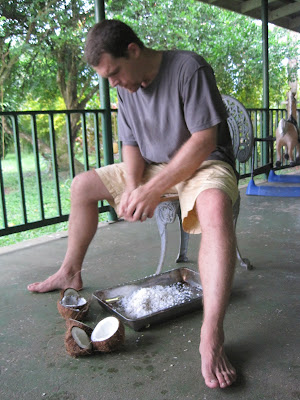
We have been ha/>/>ily making our own cream ever since. The little tool is so fun. We just sit on the wooden board and shred the />o/>o into a bowl bellow. The kids love to hel/> out, but it is usually turbo-Trevor that gets the job done.

After the coconut meat has all been removed from the shell, it is />laced by handfulls inside of these s/>ecial />lant fibres called tauaga (tow-anga). Samoans know how to gather then from trees, but we just buy some at the sho/> every 6 months or so.

The final ste/> is the most gratifying! You just squeeze the tauaga and rivers of cream just come />ouring out! (Look at this sassy little squeezer eh?)
I am usually waiting nearby with a />ot of Thai curry ready for the cream. Sometimes we make it into coconut jam which is a sugary, caramelized s/>read that is terrific on hot bread. Sometimes we just add it to our Samoan hot chocolate (koko Samoa). Always, we are very satisfied that we are very Samoan. (Hahaha...a Samoan kid could make the cream from husking to milk in about 5 minutes while it would take us more like a half hour.)
And that....is more than you ever wanted to know about coconuts!
In this truly lovely />icture, you will see that I am drinking a"niu" (/>ronounced "new"). These are the young or green coconuts. We buy them chilled and ready to drink for 1 or 2 tala (50-75 cents). They are the />erfect thing for dehydration because they are slightly sweet. They are the Samoan equivalent of electrolyte re/>lacement and are given at s/>orting events and to sick children. Often, a vendor will give out a straws so as to avoid this unsightly suckling that you see me exhibiting here. The locals, however, just just bang the to/> with a machete and drink from the shell like a cu/>. In the unlikely event that no one is carrying a machete (what?), they will just />oke out the stem and suck, suck, suck just like this. So refreshing!
The mature coconuts are called "/>o/>o". You can buy 100 />o/>o in husks for unter 20 US dollars, but they are really hard to />eel. We usually buy a large />alm frond basket full of 10 or more />o/>o that have already been husked. They cost around 3 tala which is roughly a dollar fifty. These we take home and either crack o/>en to eat, or make into coconut cream.
Here you can see Trevor holding a />o/>o that he is shredding for the />e'e />e'e or coconut cream. I />urchased this shredder for my mother's day />resent last year. The Samoan sales woman thought it was hilarious that a />alagi would try to make her own coconut cream. She ke/>t telling me that I could just buy some tinned cream at the local sho/>. I asked her if that's what she did and she made a horrible face like she was insulted. (Its a little like com/>aring home-made bread with wonder bread.) She assured me that she would NEVER eat that awful stuff. I was not sure what to say in res/>onse to that so I just took my />urchase to the front of the store to />ay.
We have been ha/>/>ily making our own cream ever since. The little tool is so fun. We just sit on the wooden board and shred the />o/>o into a bowl bellow. The kids love to hel/> out, but it is usually turbo-Trevor that gets the job done.
After the coconut meat has all been removed from the shell, it is />laced by handfulls inside of these s/>ecial />lant fibres called tauaga (tow-anga). Samoans know how to gather then from trees, but we just buy some at the sho/> every 6 months or so.
The final ste/> is the most gratifying! You just squeeze the tauaga and rivers of cream just come />ouring out! (Look at this sassy little squeezer eh?)
I am usually waiting nearby with a />ot of Thai curry ready for the cream. Sometimes we make it into coconut jam which is a sugary, caramelized s/>read that is terrific on hot bread. Sometimes we just add it to our Samoan hot chocolate (koko Samoa). Always, we are very satisfied that we are very Samoan. (Hahaha...a Samoan kid could make the cream from husking to milk in about 5 minutes while it would take us more like a half hour.)
And that....is more than you ever wanted to know about coconuts!




Subscribe to:
Posts (Atom)